
Chapter One: The Worst Thing I've Ever Done.
An exclusive extract.

I’ve previously shared the Prologue from my new novel, The Worst Thing I’ve Ever Done, here.
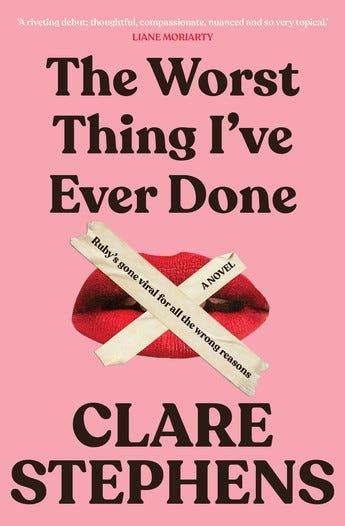
Below, I’m sharing Chapter One exclusively with my Substack subscribers. The novel will be released on September 30 with Atlantic Books (Allen & Unwin), and I’ll be launching it in Sydney (you can get tickets here!)
You can pre-order The Worst Thing I’ve Ever Done via Booktopia or Amazon/Kindle or Big W or anywhere you get your books, really. If you’re not in Australia, both Booktopia and Amazon ship internationally.
Part One
Chapter One
At first, I was sure it was someone else’s phone. The familiar vibration had been incessant and irritating, sinking into the timber surface of the long table until it seemed to be all around us, disturbing the air like a freight train. It was only when Sarah twisted her phone out of the pocket of her tailored pants, looked vacantly at her screen and tucked it away again that I thought to check my own.
My rose-gold block of metal was sitting facedown beside my laptop, a gesture that had somehow become acceptable in recent years. In our social lives and in the workplace we laid our phones in front of us like weapons, as if to say: I will put the source of my distraction in front of me so you know I am genuinely listening.
I had just tapped my screen to life when Ian turned to me and spoke. He always addressed me with an upward inflection, as though my name itself was a question. It had the effect of making him sound insincere, like he was role-playing his job as publisher, performing a character he didn’t quite believe in. With the room’s attention on me, I ignored the blur of messages and notifications and calendar reminders that had lit up beneath my thumb, and discreetly lowered my phone to my seat. I slid it beneath my thigh, feeling the throb of it against my skin. The bursts were short, like a pulse, not from a phone call but from something else: an email thread or a reinvigorated group chat or an app I regularly thought about deleting.
Bared’s reach, Ian was saying, was the highest it had been since we launched. His gaze shifted from me to the slide that now glowed against the white-brick wall at the front of the room, and he explained it in detail, as though none of us were capable of reading a graph. A series of tiny black dots were joined together by a single, volatile line—one that dipped the month there’d been an unexpected algorithm change, and spiked the month a local influencer had been exposed for abusing her toddler. Since I— as editor-in-chief—had been given the resources to hire more people in the content team, the line had climbed rapidly, buoyed by a royal scandal and the cursed press tour for a Hollywood blockbuster and an anonymous story from a woman who sent nudes to a guy who turned out to be her dad. Most recently, a new interview series about hidden abuse in intimate relationships had gone viral. The series struck the rare, sought-after balance of driving traffic and serving a greater purpose— persuading our audience to pay attention, just for a moment, to something that actually mattered.
‘It’s been an exceptional quarter for site traffic and social engagement,’ Ian said, leaning back in his chair with his arms folded. He was tall, well over six foot five, and I’d never seen him look comfortable on a piece of office furniture. It was as though he was moving through a dollhouse, a place made of small things with small, disposable people, all of which he could crush with the sole of his foot or the palm of his hand. I found myself involuntarily desperate for his approval, this even-tempered giant. He didn’t need to raise his voice or send strongly worded emails because the fear was already there, looming like a face pressed against a doll-sized window.
Being scared of Ian was partly what motivated me at work, but in truth, my job felt like a reflex. A skill I’d been honing ever since I’d discovered the internet. I had a savant-like ability to predict what an audience would care about, the kinds of headlines they’d click on, the posts they’d like, the videos they’d watch and comment on and share. I knew how to find the angle in a mainstream news story that would hook a person mid-scroll, that would draw them in and keep them there, that would answer the question they didn’t even know they were asking. I knew how to read the mood online. To tap into the base instincts of human curiosity. To offer you the content you couldn’t resist.
In a recent pitch meeting on a day where we were desperate for traffic, I’d announced that we needed to prioritise one kind of story and one kind of story only: anal sex gone wrong.
‘It works every time,’ I said, wincing. ‘I just think today they want poo on the sheets. An upset tummy. Spicy food and then some badly timed experimentation. That sort of thing.’
Amelia, one of our senior writers whose idealism had been crushed from her time working at a tabloid, nodded. ‘Yes! I feel like society is yelling at me to try anal and all I can picture is a nugget on the bed.’
‘It has to be happening all the time,’ I said. ‘You can’t have a mass adoption of butt plugs without a few accidents, surely? Also, we need a ghost story. Just noises, a door slamming, maybe a kid with an imaginary friend who ends up being a dead person. No figures or apparitions or anything; that’s when it starts to sound like bullshit.’
Over the course of a week, both stories attracted more than a million page views.
Now, Ian waved towards the data and returned his gaze to me. ‘So what are the insights? The learnings? What can we take from this to get to our BHAG?’
I cringed every time someone used an acronym at work, but I never felt more embarrassed than when ‘Bee-Hag’ was said out loud. It stood for Big Hairy Audacious Goal, and I think I avoided ever saying it out loud, but if I did, I deserve to have a shoe lobbed at me. Maybe a BHAG made sense in the context of humans landing on the moon, or civilisation-disrupting companies like SpaceX or Google, but Bared was only a year old, had twenty-five employees, and most of them just wanted someone to fix the air conditioning. We were one of many outlets under the umbrella of Simmons Corp, and given that we all knew they could close us down tomorrow with very little impact to their bottom line, it was hard to imagine any goal of ours being particularly audacious.
Still, Ian had asked me for insights, and I couldn’t tell him that the team’s most significant learnings of late were about poo and ghosts. He wasn’t heavily involved in the day-to-day of what we produced, insisting he trusted me with the ‘content side’ of the business while he prioritised revenue. He’d hired me to set the brand’s agenda, to build our audience, to be the external face of it all, because apparently a Rolex-wearing tech entrepreneur with salt-and-pepper hair was not a compelling image for a left-leaning, feminist, youth publication.
While I spoke, explaining how our audience’s habits were changing, how we’d been investing more resources in short-form video, how news stories resonated most in the morning and personal stories in the evening, my phone continued to buzz. It was bothering me now, the relentlessness. Sometimes it would slow for a few minutes, and I’d think whatever it was had ended, then it would pick up again and I’d get the desperate urge to escape the people I was sharing a meeting room with and attend to the ones in my phone.
Maybe things would’ve been different if I’d listened to that instinct. If I’d seen it all right at the beginning, the flood of grey, rectangular boxes housing snippets of phrases I would slowly realise were about me.
But I didn’t. Instead, I let the vibrations howl against my flesh, and waited for the meeting to end. I sat through the revenue updates and the plans for the site redesign and the ever-increasing traffic targets for the next quarter.
When the others closed their laptops and picked up their coffee cups and slid their chairs out, leaving behind the slightly chemical smell of overheated technology, I remained in my seat and reached for my phone. Immediately, in the fraction of a second it took to wake my screen, I knew something was not right. Swimming in the stream of alerts that dripped one after the other, like a bottomless waterfall, I saw a name that should not have been there. A name that sent icy shards of adrenaline through my veins and froze the air in my lungs.
Why was it staring back at me, over and over again, in a context it did not belong?
Above it and beneath it were other words, other messages.
This is fucked, are you okay?
Call me when you see this
Dude wtf I just saw what’s happening
And then there were the adjectives, fired at me from accounts I didn’t recognise.
dumb
embarrassing
hypocrite
manipulative
cum stain of a human
The day around me—the chatter and the targets and the list of urgent tasks—faded into the periphery. There was only the rushing surge in my phone, swelling at a faster rate than I could grasp. A person, a real person, was speaking now, suddenly in the room when she hadn’t been before.
‘Ruby? Have you seen it? I didn’t know if you were looking at your phone.’
Yasmin, the managing editor, was standing beside me, her voice high and shaky, the way it was when she’d had to deal with a legal issue in my absence. There was dried saliva in the corners of her mouth and her arms hung stiffly by her sides, as though they didn’t know what to do when they weren’t attached to something she could type on. The door, I could see, was closed. Yasmin must’ve shut it on the way in.
‘I don’t want you to panic,’ she said, trying and failing to wheel out a chair that was trapped behind a table leg, forcing her to contort herself in order to sit down. ‘But there’s this video. And it’s about you.’
Praise for The Worst Thing I’ve Ever Done
‘The Worst Thing I’ve Ever Done is a riveting debut: thoughtful, compassionate, nuanced and so very topical. I couldn’t stop thinking about it after I turned the last page. Clare Stephens keeps you on the hook—and doesn’t let you off!’
Liane Moriarty, author of Here One Moment
‘As compulsive as any app. Clare Stephens creates a cautionary tale for our times, full of wit and nuance.’
Jane Harper, author of Last One Out
‘Clare Stephens has written the kind of debut that feels both urgently contemporary and quietly profound. The Worst Thing I’ve Ever Done is sharp, insightful and deeply compassionate—a compulsive read that dares to ask what happens when we become the object of the scrutiny we so casually dish out. With elegant prose and unflinching honesty, Stephens marks herself as a striking new voice in Australian fiction.’
Sally Hepworth, author of Mad Mabel
I am so excited to be attending your book launch in Melbourne tonight and finally read the rest of this book!!
I cannot wait to read this! What an absolute cliffhanger of a first chapter — you’ve definitely hooked me.